
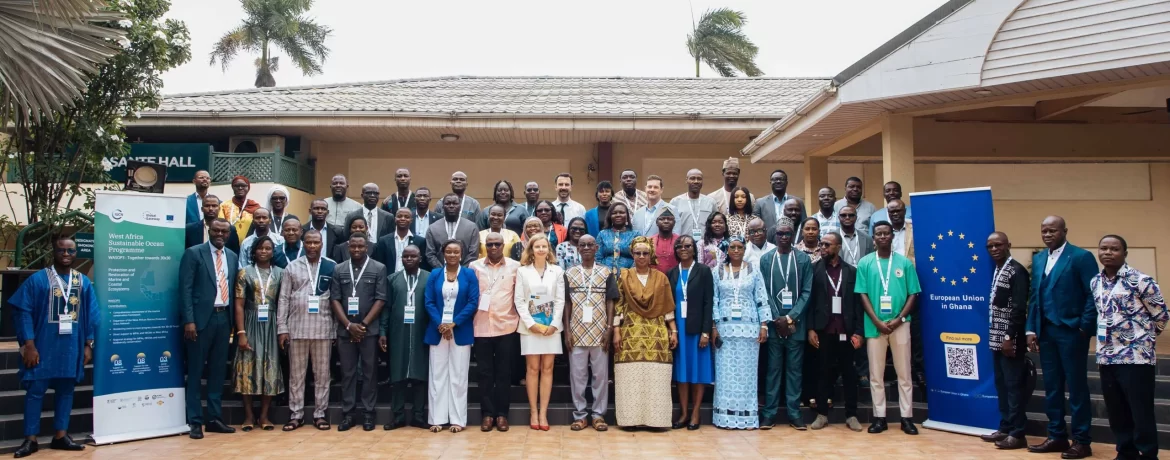
From the wetlands of Keta and Songor to the waters of the Greater Cape Three Points Marine Protected Area (MPA), Ghana has taken steady steps to conserve its coastal ecosystems. But conservationists say formal protected areas alone will not be enough to hit the global target of conserving 30 percent of the world’s land and ocean by 2030 — and that communities quietly protecting biodiversity outside those formal boundaries need to be brought into the system.
That was the focus of a four-day meeting in Accra, from July 28 to 31, 2026, where representatives from 13 West African countries gathered to build a common approach to identifying, assessing, and formally recognizing what are known as Other Effective Area-Based Conservation Measures (OECMs). The meeting also aimed to strengthen cross-border cooperation in protecting the region’s shared marine and coastal ecosystems.

Livelihoods under Pressure
Along Ghana’s coastline, the sea provides food, jobs, and income for millions of people. But the ecosystems sustaining those livelihoods are under growing strain — from declining fish stocks and disappearing mangrove forests to illegal fishing and climate change.
Ghana has responded by establishing several biodiversity conservation sites, including the Keta Lagoon, Songor, Sakumo, and Densu Delta Ramsar Sites, along with the Greater Cape Three Points MPA. Yet experts say these formal protected areas represent only part of the picture. Many ecologically important sites — community-managed mangrove forests, traditional fishing grounds governed by customary rules, and Community Resource Management Areas (CREMAs) — already deliver real conservation outcomes but remain outside the formal system and unrecognized under the Convention on Biological Diversity (CBD).

What Qualifies as an OECM?
Unlike protected areas, OECMs recognize places where effective governance and sustainable management deliver long-term biodiversity conservation, even when conservation is not the site’s primary purpose.
Dorcas Owusuaa Agyei, IUCN Country Representative in Ghana, told Radio Ghana that the CBD has set out four main criteria for establishing an OECM:
- The site must be geographically defined
- It must be well governed
- It must deliver effective, long-term conservation outcomes
- It must not already be recognized as a formal protected area
She linked the effort to the global 30×30 Framework, which calls on countries to conserve at least 30 percent of their land and marine areas through a combination of protected areas and OECMs.

Ghana’s 30-Year Journey
Ghana’s push toward MPAs is not new. Professor Francis Nunoo, a fisheries scientist at the University of Ghana’s Fisheries Department, said the country began working toward formal marine protection more than 30 years ago but struggled to see it through.
The push gained fresh urgency once the CBD came into force and Ghana developed its National Biodiversity Strategy and Action Plan, creating pressure to meet international obligations. A study involving Prof. Nunoo back in 2018 identified 21 potential sites that could qualify. “We are going to sit down… to identify which of them could qualify, using the assessment criteria, as OECMs to be included in the updated National Biodiversity Strategy Plan,” he said.
Kofi Agbogah, Chief Executive of Yen Poano, a civil society organization working on coastal and marine governance, noted that Ghana and other West African countries are still building the scientific evidence and policy frameworks needed to formally qualify sites — putting them behind East African nations like Kenya and Tanzania, which started the process much earlier and now have more MPAs.
A Regional Opportunity: The Gas Pipeline Corridor
One idea that emerged from the Accra meeting: using the security zones around the West African Gas Pipeline as a foundation for regional OECMs.
Agbogah said that if Ghana, Togo, Benin, and Nigeria each established OECMs around the pipeline corridor within their waters — currently protected solely by the facility’s own managers — it could serve a dual purpose: strengthening conservation while addressing illegal bottom trawling and security threats to the pipeline itself.
“If we bring Togo, Benin, and Nigeria to all create OECMs around the gas pipeline… this will also address the issues of bottom trawling and security threats to the facility, and add to conservation measures,” he said, adding that fishing communities across the region need more education about the pipeline’s importance — “not only to Ghana, but the whole sub-region.”
EU Backing and Regional Stakes
The European Union is supporting the initiative with €59 million, of which €17 million comes through the International Union for Conservation of Nature (IUCN), directed toward protecting and restoring marine and coastal ecosystems.
Paulina Rozycka, Head of Infrastructure and Sustainable Development at the EU Delegation to Ghana, said the funding reflects the EU’s commitment to improving ocean governance, supporting the blue economy, and building resilient coastal communities.

Ghana’s Minister for Fisheries and Aquaculture, Emelia Arthur, in a speech delivered on her behalf, called for stronger regional cooperation to tackle illegal, unreported, and unregulated (IUU) fishing across the Gulf of Guinea. She said formally recognizing OECMs would complement Ghana’s existing conservation efforts and help the country meet its CBD commitments.

What’s Next?
Participants at the workshop worked in groups to map out potential OECMs — complete with proposed boundaries and governance structures — and how the criteria could apply in their national contexts.

With just a few years left to reach the global 30×30 target, conservationists say success will hinge on more than expanding formally protected areas. It will require recognizing and supporting the communities that have quietly safeguarded forests, wetlands, and coastal ecosystems for generations. As one participant puts it, protecting biodiversity is as much about empowering local people as it is about conserving nature itself.
Story By: Joyce Gyekye
Sourrce: gbcghanaonline